
3D configurators have quietly become standard equipment on car maker websites — Porsche runs one, Xiaomi runs one. They look like visual polish, but what they actually carry is the options logic: how hundreds of configurable items get explained, how pricing stays transparent, how parameters interact, and how a configuration turns into an order. None of that logic is exclusive to car makers. Tuning brands, motorcycle companies and auto-parts exporters can borrow all of it.
Paint in Four Price Tiers, Every Line Item Priced
Porsche's China configurator prices paint in four tiers: standard colors at no charge, Legends colors north of twenty thousand yuan, historic Paint to Sample colors above one hundred twenty thousand, and full Sonderwunsch custom finishes at two hundred eighty thousand. Wheels are priced with the same discipline — lightweight wheel sets near one hundred forty thousand, titanium bolts listed individually. What you choose and why it costs more are on the table.
That transparency buys trust in a way copy never will. A car is a large-ticket decision, and opaque quotes trigger suspicion; itemized differences let buyers keep configuring because the premium is explained up front. Transparent is not the same as cheap. It means answering "why is this expensive" before the question is asked.
Options Talk to Parameters, Wheels Change Range
Xiaomi's configurator has a detail worth studying: 19-inch wheels correspond to 835 km of range, and stepping up to 21-inch drops it to 810 km. Wheel size affects drag and weight, and that physics is wired straight into the displayed parameters.
This is the real divide between a configurator and a photo grid. On static pages every option is an isolated image; in an interactive 3D product page the consequences of a choice update live. The buyer is no longer picking a color — they are understanding how the vehicle works as a system, and understanding shortens hesitation.
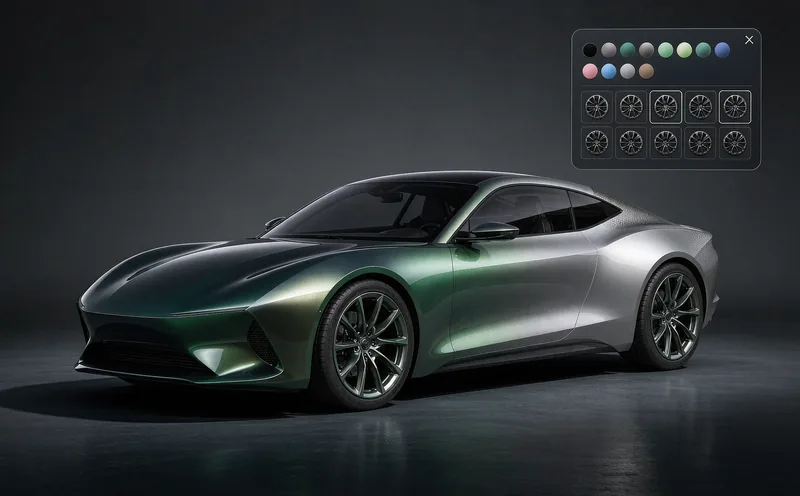
Configurator Straight to Order, Not a Showpiece
Xiaomi's flow ends in order lock-in with a delivery estimate on screen. Porsche's ends in a complete configuration sheet that a dealer can pick up and act on. At that point the configurator is no longer marketing material; it is the front door of the sales process.
For heavily customized products this is the natural design. The RC401 C2M selection screen we built for Zongshen motorcycles runs on the same principle: customers finish their selection on a large-format screen and the configuration flows through the system, no paper forms at the dealership. A large share of customized-product sales cost goes into turning what the customer says into an accurate order document, and the configurator automates exactly that step.
The Toyota SUPRA 3D interactive project works the same way — paint swaps, doors opening and closing, dimensions on display — so by the time a buyer reaches the showroom, the conversation is only about price and delivery.
Xuanji Animation has spent more than eight years on this and delivered five hundred plus projects, with configurators running from furniture and lighting through motorcycles and cars. The common thread: products with many decision variables and complex combinations benefit most, because photos and tables cannot carry the logic. The dealer-side view of that flow is covered in our piece on motorcycle option configuration.
To evaluate a model line, the custom 3D configurator development page has the entry point; assessments cost nothing.
Related Q&A
What does a car 3D configurator cost?
It scales with model count and options depth. One finely modeled vehicle with full selection logic versus a whole lineup tied into inventory differ by multiples. The sane path is launching the flagship model first, measuring online leads and showroom conversion, then expanding.
Does the mobile experience suffer?
No, provided models are built to mobile weight standards. Most configurator traffic is mobile anyway, and touch drag is naturally suited to walking around a car — as long as the model loads instantly on a phone.
Should configurator prices match the dealer system?
They must. The moment the on-screen price diverges from the dealer quote, trust resets to zero. Sorting the pricing system out — option definitions and promotion stacking rules — is part of the project, and often weighs as much as the modeling itself.