
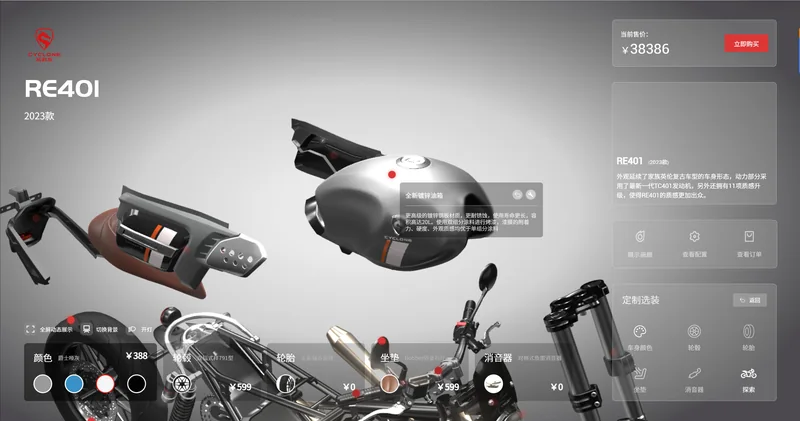
Motorcycle option configuration is messier than most people outside the industry expect. A single bike carries groups of choices just on the outside: paint, decals, wheel style, exhaust shape. Add seats, screens, panniers, crash bars and luggage racks and you are looking at tens of thousands of buildable combinations from a modest parts catalogue.
Most manufacturers still run that complexity on spreadsheets, PDFs and whatever the salesperson can remember.
A customer sits down in the dealership and asks whether the red will work with the black wheels. The salesperson either digs through a price list or calls the factory. They quote, the customer wants a different wheel, and the quote gets rebuilt from scratch. One wrong part number and the order reaches the factory wrong. Nobody finds out until the bike is built.
We have worked on this problem for a few years now, and it stopped looking like a catalogue management issue quite early on.
The real problem is how information travels
The factory knows every rule. The customer knows what they want. Between them sits a salesperson, and that layer communicates through memory, spreadsheets and phone calls.
Information degrades three times along that path.
Say "matte black body with racing red wheels" to a customer and there is no picture in their head. The photo they found online is a different model, different lighting, different angle. The showroom demo bike is one build, and it is not theirs. So they imagine it, and humans are bad at imagining paint.
The salesperson's problem is more concrete. Options are not free combinations. There are exclusions and dependencies. Changing the exhaust can affect where the panniers mount. Adding a top box changes weight and suspension expectations. At the factory this lives in a compatibility matrix. In the dealership it lives in one person's memory. When memory fails, you make a call and wait, and while you wait the customer is on their phone.
Further down is the order itself. A paper form or a WeChat screenshot arrives at the factory and someone has to reinterpret what the customer actually asked for. The same "matte black" might map to three different process codes on the price list. Copy one character wrong and you build a batch of the wrong parts.
Stack those three failure points and you get the familiar pattern: slow quotes, constant change orders, rework, frustrated dealers, and a factory convinced the dealers are unprofessional. Nobody did anything wrong. The chain simply has no tooling.
A 3D configurator is about consequences, not rotation
Most people still read "3D configurator" as "the bike spins so you can look at it." That is a viewer, not a configurator.
The job is to make the consequence of every click visible immediately. Change the paint and the bodywork changes now. Add panniers and the visual weight at the rear shifts. Switch the exhaust and the description follows. Price moves in the corner with each selection rather than appearing as one number at the end.
That difference sounds cosmetic. It is not. Customers start trading off on their own: the top box looks good but costs two thousand more, so it stays off. When that trade-off happens in the buyer's hands, deals close faster than any explanation a salesperson can offer.
When we built the motorcycle 3D configurator case for Cyclone, Zongshen's premium brand, the first argument was not about model quality. It was about the order the options appear in. What goes on the first screen, what folds away, what hides itself when it conflicts with something already chosen. Those decisions determine whether a buyer survives to screen three. A good model is table stakes. Wrong sequencing kills it anyway.
The C2M dashboard is what turns configuration into a transaction
On a phone, the configurator belongs to the customer. On a large touchscreen in a dealership, it belongs to the salesperson, and the two jobs are not the same.
One is a slow, exploratory session at home. The other has to produce an answer in three minutes. So the big-screen build got a different interaction model entirely: oversized buttons, large type, no decorative transitions, a back step that always works, and a running total that never leaves the screen.
Finish a build and it generates a configuration sheet with a build code and an itemised price. The customer confirms, scans a code, and the order lands in the factory queue. The salesperson transcribes nothing.
Once that loop closes, the nature of the thing changes. Configuration stops being a communication aid and becomes a transaction tool. What used to take forty minutes of explaining and confirming now happens while the customer taps through the screen, and the salesperson only negotiates price and delivery.
Royal Enfield took a different route. They put the configurator inside their own app, tied it to 320 stores, and let buyers personalise at the booking stage with a visible delivery window, with factory build times of 24 to 48 hours. Dab Motors went further in the other direction, opening more than a million combinations online with the price attached in the configurator itself.
Different strategies, same underlying move: configuration left the conversation and entered the workflow.
What actually goes wrong during delivery
3D configurator development process budgets are usually blown on the least glamorous part. Clients think they are buying models and an interface. More than half the timeline goes into extracting rules from their own people. Which parts exclude each other, which must be chosen together, whether a colour carries a surcharge and how much. That knowledge sits in the heads of two or three senior salespeople. Getting it out, written down and turned into code is tedious and slow, and it is where schedules die.
Asset standards have to be settled before anyone opens a modelling tool. Parts separated, materials layered, naming consistent. Retrofitting those standards later is painful, especially when a product refresh adds new colours and the original model was exported as one solid piece.
Dealer adoption is a real problem and it is not technical. Some stores are comfortable with paper and will ignore a screen. Either make the kiosk the centrepiece of the showroom so customers walk up to it first, or fold the training into the opening support package. Shipping a URL and hoping is not a rollout.
Device testing catches people out as well. Finger input on a touchscreen is nothing like a mouse. Hit areas need to grow, hover states have to go, scrolling needs momentum. None of that shows up on a desktop monitor. It has to be tuned on the actual hardware, in the actual store.
How big should the first phase be
Do not start with the full model range.
Pick the best-selling bike. Put body colour and ten to twenty high-frequency options into it. Run it for one to three months and watch three numbers: average time on the configurator, configuration sheet submission rate, and change-order rate. If those move, expand to more models and parts. If they do not, something in the rules or the interaction is wrong, and more budget will not fix it.
Once the front end behaves, connect the factory order system or ERP. The value of C2M is data continuity, but continuity only pays when someone is already using the front end. The full 3D configurator development scope usually gets sequenced this way for exactly that reason.
Back to the original question. Motorcycle configuration breaks at the dealer because the customer, the salesperson and the factory have no shared, live, viewable thing to work from. It is not a competence problem and it is not a catalogue problem. The 3D configurator handles seeing. The C2M dashboard handles calculating and ordering. Finish both and the chain finally closes.
FAQ
How different is a motorcycle configurator from a car configurator?
Same technology, quite different interaction logic. Cars sell option packages (appearance pack, driver-assistance pack). Motorcycles sell individual bolt-on parts, and physical interference between those parts is far more common: exhaust against panniers, crash bars against fairing panels. The rules layer has to be considerably more detailed.
Does C2M require connecting to the factory ERP immediately?
Not necessarily. You can launch with configuration sheet generation and scan-to-order, with structured orders landing in an intermediate queue that someone reviews before entering the ERP. Connect the API once the front end is in real use. Demanding full automation on day one usually parks the project behind the factory IT queue.
What if dealers refuse to use it?
Start with what they gain. If the kiosk means fewer change orders, less rework and faster quotes, they will use it. Resist measuring adoption in phase one and let them feel the relief first. Putting the screen where customers walk in also helps, because the salesperson ends up following the customer's lead.