
Every furniture seller has the same painful moment. The customer seemed happy, the order shipped, and then the return request lands: "it looked different in my living room."
The numbers behind that moment are ugly. Furniture has the highest return rate of any e-commerce category — 15.8% — and one return on a sofa costs $100–400 in reverse logistics alone, before refurbishing and re-storage. And here's the part that matters: furniture returns are almost never about quality. They're about imagination gap. The sofa looked bigger in the photo, the fabric reads a different color under the customer's own lighting, the proportions collapse the moment the piece enters a real room. A returned made-to-order piece usually can't even be resold, so every one of those returns is a total loss.
Do 3D configurators actually fix this? The published data says yes, more aggressively than most sellers expect.
Vendors in the furniture visualization space report return-rate reductions of 40–80% on configurable furniture once buyers can confirm their exact configuration before paying — dimensions shown to the millimeter, fabrics previewed under realistic lighting. Wayfair, after heavy investment in AR placement, disclosed that products with AR previews run roughly a third of the return rate of photo-only listings. For custom and personalized pieces the effect is even sharper, because there is no resale channel for a returned custom sofa.
The conversion side is just as direct. Shopify's own numbers put conversion lift at up to 94% on product pages using 3D and AR. Buyers who interact with a 3D model are 44% more likely to add the product to their cart. And configured orders carry higher values — typically 20–30% higher AOV — because of a psychological effect economists call endowment bias: a customer who just spent ten minutes choosing the fabric and layout already feels ownership of that sofa. Walking away is harder now.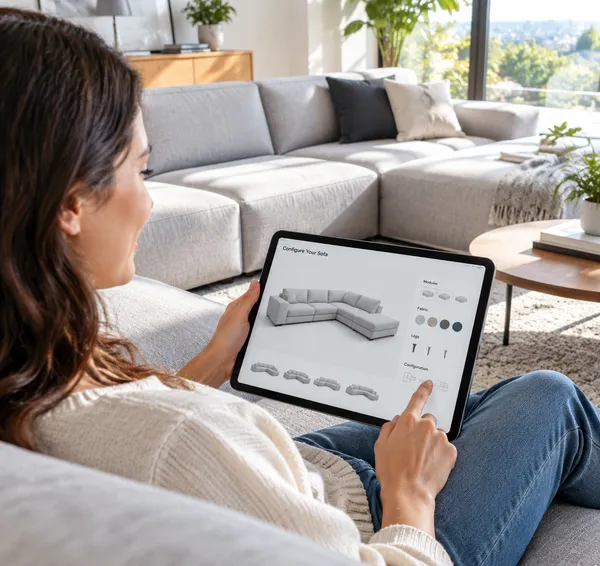
There's a second pile of money that almost nobody counts: content production.
The traditional workflow shoots about 20 images per SKU, and industry surveys report 96% of retailers struggle with asset creation — cost, resources, and demand for variety all stack against them. A single well-built 3D model replaces hundreds of product photos: every color, every angle, every lifestyle render comes out of the same asset, and new launches or seasonal updates don't need a photo studio anymore. Industry estimates put photography and content savings at up to 70%, and that freed budget usually goes straight into ads.
So how do you actually start without betting the whole catalog?
Pick your best-selling 20–40 SKUs, model them to "configurable from day one" standards (parts separated, materials layered — skipping this is the most expensive shortcut in the industry), and validate conversion and return data on real traffic before expanding. Model costs run a few hundred to a few thousand dollars per product depending on complexity; we broke the full pricing down in our configurator cost piece. AR and room planning make a natural second phase — the models already exist, so adding them costs little. Test the hero products first, let the data argue for the rest. For furniture, configurators have stopped being a nice-to-have. They're infrastructure.
FAQ
Is a 3D configurator worth it for a small furniture brand?
Yes, but stay narrow. Two or three configurators on your main lines, validate the numbers, then expand. Published payback periods for small and mid-market brands run 12–36 months, assuming your traffic and order values have a basic floor.
Will return rates really drop that much?
The 40–80% range sounds aggressive, but the mechanism holds: most furniture returns come from expectation gaps, and configurators close those gaps before payment. Track your own return rate and return reasons monthly — let your data make the case.
How long before we see results?
Engagement and configuration interaction change the day the page goes live. Conversion and return data need two to three months to be meaningful — small samples lie.