
Here's the trap most furniture and equipment brands fall into. They decide to add AR, they hire an agency, they ship a mobile app — and the app dies on the third screen of the customer's phone. The data on why is brutal. Requiring an app download before anyone can experience your AR creates a 70–80% drop-off. Customers will not install a piece of software just to glance at a sofa. So you pay for AR that maybe 20% of your visitors ever touch. The way out is WebAR — augmented reality that runs in the browser. No app store, no install, no icon hunting. The EQ3 case is the one everybody cites, for good reason. The Canadian furniture retailer plugged WebAR into its product pages: tap "View in Your Room," the camera opens, the sofa lands in the customer's actual living room at true scale. Their published numbers — customers who used AR converted at 112% higher rates than those who didn't, and AR users' average order values ran two times higher. Interior Define's figure is wilder: customers engaging with AR were eight times more likely to convert. And one agency published a complete A/B test — AR-previewed products returned 27% less than photo-only purchases. The logic underneath all of it is plain: for big items, the last question before checkout is "will it fit and will it match," and AR answers that question before payment instead of after delivery.
Why does "no app" matter so much? Lay the two funnels side by side.
App path: product page → leave the site → download → wait → open → search for the same product → launch AR. Every step leaks people. WebAR path: product page → one button → camera on. Nothing in between. The technology stopped being an excuse a while ago — AR Quick Look on iOS, Scene Viewer on Android, standard WebXR, all native in mainstream browsers with no plugins. Desktop visitors get covered too: a QR code on the product page hands them the same AR view on their phone, which is exactly how EQ3 reached its whole customer base.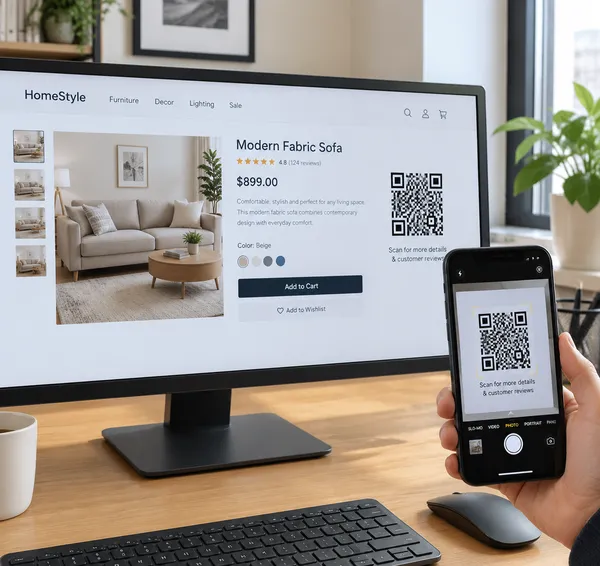
Which products deserve WebAR first?
One test: is "will it fit, will it match" the last open question before the customer commits? Sofas, beds and dining tables top the list — they eat floor space and dictate traffic flow. Wardrobes and TV units need wall alignment checks. Lighting and appliances are size-and-fit questions too. Small, standard, buy-on-looks products? AR adds little there. B2B equipment follows the same logic — showing a machine standing on the customer's actual shop floor beats emailing a spec sheet, and our dispensing machine configurator case is a close cousin of exactly that approach.
Costs and pacing, so you can plan
The common pattern is a pilot: model your top 20–40 SKUs, launch in 30–60 days, watch engagement and conversion data, then decide about catalog-wide rollout. Models need to be built to AR-ready standards — true dimensions, accurate materials, projectable geometry — so the same asset powers the configurator, marketing renders and AR at once. Per-model pricing runs a few hundred to a few thousand dollars depending on complexity; we broke the full breakdown down in our configurator cost piece. A catalog-wide rollout typically adds another two to four months. Bottom line: AR isn't a party trick, it's the answer to the last question your customer was going to ask anyway. Run a WebAR pilot. Skip the app. That's what the current data supports.
FAQ
Is WebAR visual quality good enough?
Yes. Native AR rendering in modern mobile browsers handles furniture-grade models comfortably, and true-to-scale placement often looks more convincing than brand apps. What actually makes or breaks the experience is model quality — bad materials ruin it no matter the platform.
We already have an app. Do we still need WebAR?
Depends on your app's active user base. If the app has hundreds of thousands of engaged users, in-app AR has value. If it's mostly a shell, WebAR on your product pages covers every visitor, and the two don't conflict — start with the bigger audience.
What does a WebAR pilot cost and how long does it take?
A 20–40 SKU pilot typically launches in 30–60 days, with cost concentrated in modeling and page integration. Full catalog rollout adds another two to four months. Run the pilot on real traffic before committing to the rest.