
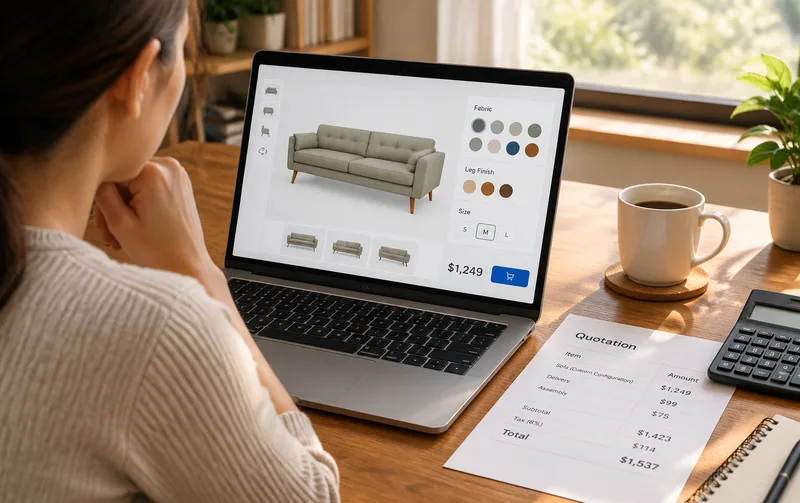
"What's this going to run me?" Every single call starts there. Not rendering quality, not WebGL, not AR — price, straight up. And after enough of these calls I've stopped being surprised by the spread: we've quoted the same product category at $4,000 and watched enterprise vendors come in north of $150,000 a year. Nobody's lying in those quotes. They're just selling fundamentally different things, and almost nobody explains that part clearly. So here's the honest version. Three tiers that actually exist in the market right now, what quietly inflates each bill, where the models fit in, and the payback math I'd run before signing anything.
Three tiers, three totally different purchases
The fastest route is a SaaS subscription. Entry plans — Zakeke is the usual benchmark — start around $29–59 a month, they'll handle basic color or text personalization without a developer, and plenty of small stores launch from there, which is fine, that's what they're for. Mid-market platforms with real real-time 3D rendering run $300–2,000 a month. Enterprise platforms like Threekit play in another league entirely, and independent 2026 aggregations put them at $30,000–150,000+ per year, generally before render credits and per-SKU asset fees. Two things to watch in this tier: some plans take a commission on sales (one well-known platform charges 1.5–1.9% on top of the subscription, which stings exactly when your configurator starts working), and the subscription never stops — one 2026 comparison of 12 vendors calculated that enterprise SaaS reaches €220,000–700,000+ by year three. Rent, not ownership. Sometimes renting is the right call. Sometimes it's just a very long lease on something you could have built. If you're on Shopify and want to see what integration actually involves, we covered the whole process in our Shopify 3D configurator guide. Rent versus own. That's the fork in the road.
Custom build: what it actually runs
A custom configurator is built around your catalog, your pricing rules, your systems. The 2026 market aggregates out roughly like this: a single product with no integrations, $4,000–10,000; a multi-option build with a rules engine and live pricing, $10,000–30,000; enterprise CPQ wired into an ERP, $30,000 and up with no real ceiling. Most of the projects we quote for overseas clients land in that middle band — a furniture configurator with sizes, materials and live pricing (our furniture case is public if you want to poke at it) doesn't need the machinery behind a 500-SKU industrial catalog, and it shouldn't be priced like it does. We break quotes into modeling, interaction logic and platform integration so the number maps to visible work instead of being one black-box figure. And the amortization is the part worth staring at: a $15,000 build spread over five years is $250 a month, while a $1,500/month SaaS platform is $90,000 over the same five years. Past the three-year mark, owning usually wins, and it isn't close. Models are billed separately. The line item everyone forgets: model production Whatever tier you pick, somebody produces the 3D models, and that's its own budget line. Market rates for web-optimized models run $200–1,000 per product, furniture typically lands between $180 and 500 per SKU, and complex multi-part industrial pieces can push $2,000–10,000. Three variables move the number. First, whether you have CAD files — starting from CAD is hours of cleanup, starting from photos is days of modeling, and this one detail can double or halve a quote. Second, material count: three colorways is an afternoon, forty fabric references is a week of somebody's life, because every finish needs its own PBR texture set. Third — and this is the counterintuitive one — rule-dependent variants. Cost scales less with product count than with rules like "this frame can't pair with that door." Color and material swaps ride the material layer and come cheap; mutually exclusive combinations need a separate logic layer inside the configurator, and that layer is where the money goes. If your catalog is still growing, ask two questions before signing: can models be quoted in batches (five chairs from one range cost meaningfully less than five standalone projects), and what do revisions cost later — some vendors charge €200–500 per model update, and catalogs always change. We walked the full CAD-to-quote pipeline in our configurator workflow piece.
The payback math, one paragraph
Take a mid-market furniture store: $800 average order, 2% conversion, 10,000 monthly visitors, $160k in monthly revenue. Published Shopify data puts conversion lift from 3D configurators at 20–40% for customizable products, so taking only the conservative 20% means $32,000 a month in added revenue on identical traffic — a $15,000 build pays itself back inside a month. Returns belong in the same calculation: furniture runs a 15.8% return rate, the highest in e-commerce, and cutting the "it looked different online" returns in half can be worth more than the conversion lift itself. Industry-level data is compiled in our piece on 3D visualization and B2B inquiry rates. One caveat that every vendor's ROI slide skips: the baseline has to be real. If you don't know your current conversion rate and the true cost of one return, measure those first, because otherwise the payback spreadsheet is decoration.
Which one, then?
Tight budget, testing the waters — SaaS entry plan, zero shame in it. Shopify store, standard variant logic — mid-market SaaS or a lightweight custom build, depending on how picky you are about render quality (our bluetooth speaker Shopify case is the lightweight route). Complex rules, ERP on the roadmap, visual quality as the actual differentiator — custom, and involve the development team early, because early scoping is the cheapest scoping. The full process lives on our Web3D development services page. At the end of the day the pricing question is a scoping question. Get the scope right and the number mostly names itself. My recommendation stays the same order every time: baseline first, then quotes.
FAQ
How much does a 3D product configurator cost in 2026?
Three realistic bands. SaaS subscriptions: $29–2,000/month, enterprise platforms from $30k/year. Custom builds: $4,000–30,000 one-time, covering most catalogs. Models: another $200–1,000 per product. Ignore the first invoice and compare total cost of ownership across three to five years — a mid-market platform billing $20k/year catches up to a full custom build inside two years and keeps billing after that.
Why do quotes for the same product vary by ten times?
Because different things are inside them. Rule logic, live pricing, ERP sync, AR and model production are all separate work packages. A $5,000 quote usually covers one product with material swaps and nothing else; a $30,000 quote includes a rules engine and system integration. Compare scope line by line, never the total.
SaaS or custom build — which is cheaper long term?
Past two or three years, custom. It's really that simple.