
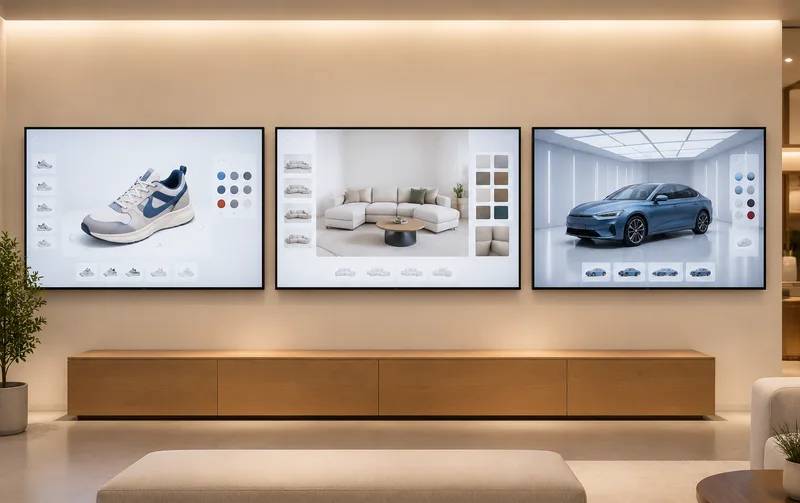
Most people look at case studies the wrong way. They open a brand's configurator, spin the model twice, swap a color, think "that's nice," and close the tab. Then their own project kicks off and they still have no idea where to start. The useful question runs backwards: what problem was this brand stuck on, and why did it choose this approach? I went through ten 3D configurator implementations across footwear, furniture, automotive and industrial equipment. Here's what actually repeats.
Footwear: the win is cutting options in half
Nike By You and Adidas' customization lines were among the first to make this work. Shoe shape, colorway, materials, engraving — the option space is enormous, yet the page always walks you through three or four steps and lands you at checkout. What they got right: they handed the SKU explosion to the 3D model. Ten thousand color combinations don't require stocking ten thousand shoes, just one model plus a material library. What you can borrow: decide which dimensions deserve to be exposed, and hide the rest. In both cases, restraint was the expensive part, not the technology.
Furniture: AR is the conversion switch
Lovesac builds modular sofas, and its configurator is not a color picker — customers assemble modules themselves, and the result maps directly to a production BOM. Threekit has published a 130% revenue increase for that deployment. Canadian retailer EQ3 took the other route, wiring WebAR into product pages; shoppers who used AR converted at 112% higher rates with double the average order value. Wayfair's AR-previewed listings return at one third the rate of photo-only ones. Interior Define's figure is even more aggressive: AR users were eight times more likely to convert. Our own furniture 3D configurator follows the same path — sizes, fabrics and interior layouts configured in the page, with live pricing attached. The difference: we skipped AR, because that client's catalog wasn't yet complex enough to need "place it in your room."
Automotive and industrial: a sales tool, not a decoration
Tesla's design studio connects configuration directly to ordering, with no salesperson in between. Mercedes-Benz's configurator has a terrifying number of options, and it solves a very practical problem: turning "what does this car actually look like" into a confirmable fact instead of a sales pitch. On the B2B side, Steelcase uses configurators for CPQ; customers pick specs and a quote appears. Our machinery 3D configurator works the same way — repeat buyers no longer call to confirm parameters one by one, they configure and send procurement a quote. The common thread: in automotive and industrial, the configurator sits inside the purchase path. It's not a decoration parked in a corner of the website.
Four patterns that repeat across all ten
Model assets must be reused. One model powers renders, AR, the configurator and marketing imagery — that's how every well-run brand amortizes the cost. Configuration and pricing belong on the same page. If customers finish configuring and can't see a price, you've pushed them back to the inquiry form, and everything upstream was wasted. Option count needs restraint. A configurator with forty fabrics on the first screen usually converts worse than one with five. And the most overlooked one: data has to flow back. Which combinations get picked most should inform production and stocking. Most brands never close that loop.
Three failure modes worth remembering
Options piled into a maze; cheap models that look like toys on the page, which damages the brand more than having no 3D at all; and no next step after configuration — cart integration missing, inquiry form missing, so customers screenshot their build and email it to a salesperson. That list is worth pinning to the project room wall.
Where to start
Find your category, copy the structure, worry about scale later. With a limited budget, one hero product done deeply beats ten products done shallowly — we broke that math down in our 3D configurator cost breakdown. To decide whether you need this at all, two of three signals are enough: your product has color, material, size or component options; the price point is meaningful; returns include "different from description." As for execution, our 3D configurator development process covers it in detail. How we run 3D configurator development at XuanJi Animation: scope the first 5–10 products, settle the rules, pricing and integrations before any code, then model and launch in roughly four to eight weeks.
FAQ
Are these case study numbers trustworthy?
They come from public disclosures by platforms and brands — Threekit on Lovesac, Cylindo on EQ3. Treat them as order-of-magnitude references, not promises. Your lift depends on your product, your traffic and the quality of the build.
Small brand, limited budget — which case should I copy?
Copy the structure, not the scale. Pick your best-selling product and build the configurator deeply: clean option logic, pricing wired in, smooth on mobile. Prove it with data, then expand.
Does a configurator have to include AR?
Large items, yes; small items, not urgently. For sofas, beds and equipment where "will it fit" is the last question before checkout, AR earns its keep. For jewelry or small electronics, get the configurator itself right first.