
However good the 3D display on your foreign-trade site looks, one fact needs stating first: Google cannot read your 3D scene. The crawler receives HTML and a script that loads a model. The cabinet rotating in the canvas, the equipment coming apart, the fabric switching — none of it exists as text. That is not laziness; it is how rendering works. WebGL produces pixels, not words.
So is 3D useless for SEO? No. It helps, but not by being indexed. It helps because the page earns attention, and because you have a reason to write searchable text around it. Keeping those two things apart is what prevents wasted budget.
Google sees the page, not the model
Crawling a 3D product page yields the title, headings, body paragraphs, image URLs, structured data and a reference to a GLB file. The GLB does not become a ranking page. It is a resource the page points at, roughly equivalent in status to a large image or a video.
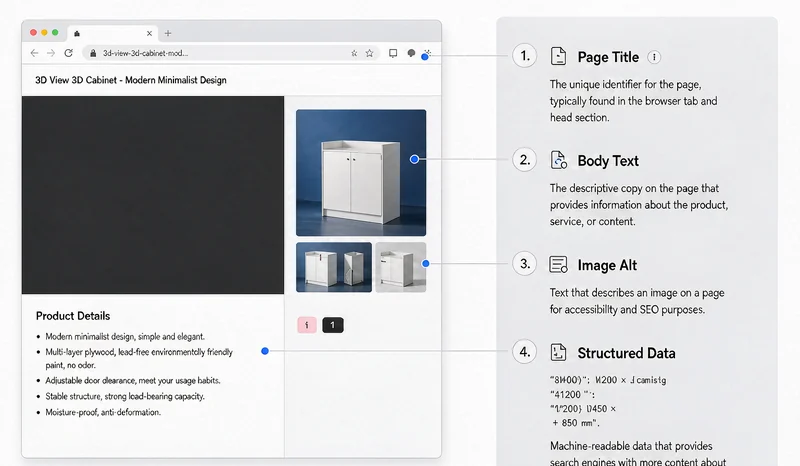
The quickest audit is to open View Source. If the source contains nothing but a canvas and a script reference — no product name, no specifications, no description, no alt text — the page is effectively empty to a search engine.
What can be read, and little else
Body copy carries the weight. What the product is, which applications it suits, what the specifications are, how common questions are answered — written out, that text is what long-tail queries can match. A 3D model replaces the step of understanding structure from pictures. It does not replace the information text conveys.
Image alt text and filenames are the second channel. 3D pages usually ship with static screenshots, detail shots and scene images, and whether their alt text is accurate affects both image search and topic understanding. A pattern like product name plus view plus finish does far more than "image1".
Video, where present, can be indexed on its own. A captioned video is worth more than a silent loop, because the caption text is readable. That is why a 3D page with a short explainer outperforms a page that only spins.
Structured data is the most overlooked item. Product markup for model, price range and brand; FAQPage for the question block; Article for editorial pages. None of it changes how the page looks, but it tells search engines precisely what the page covers and creates eligibility for richer presentation. Cost is low, return is direct, and it deserves priority.
Three common mistakes
The first is putting the 3D viewer above the fold as the hero. Models take time, and while they load the page is blank, which destroys LCP. The right pattern is a static image first with a "view in 3D" entry beside it, loading the model only on interaction. The arithmetic is in keeping models under 2MB — first-screen speed and model weight are tightly coupled.
The second is assuming a 3D model will be displayed as a 3D result in search. Whether interactive models appear in results is the search engine's product decision, changes over time, and is not something a site controls. Betting on it hands your fate to someone else's roadmap.
The third is collapsing every variant into one page. Five models in a series sharing a single 3D page means all the copy competes with itself and none of the models ranks. The workable structure is one indexable page per model, sharing a model set, with independent copy. The same planning logic applies to industrial digital catalogs.
Traffic needs searchable text before 3D can convert
One pattern stands out: identical 3D configurators perform very differently. Some pull traffic from long-tail queries about configuration and finishes; others run for six months with almost no impressions. The difference is not the quality of the 3D. It is whether the page was written around the phrases customers actually use.
Customers rarely search for "3D display". They search concrete questions: will this size fit through my door, does this finish stain, how long is lead time on this configuration. Answered in sections of real copy, those questions can be found. Compressed into a "try the 3D configurator" button, they are a feature, not content.
One counterintuitive point: much of a 3D page's value comes from dwell time and interaction depth, which act as indirect quality signals. That cannot be converted into a ranking formula, but the behavioural gap in interactive versus static product pages shows users staying longer — itself evidence the page answered something.
How to verify after launch
Start with indexing. Submit the sitemap in Search Console and watch whether indexed page count keeps pace, confirming the 3D product pages are actually indexed rather than skipped as duplicate or thin content.
Then rich results. Run product and FAQ pages through the Rich Results Test and check for Product and FAQ errors. This surfaces missing required fields and malformed markup quickly and cheaply.
Finally performance. Run mobile PageSpeed Insights: LCP under 2.5 seconds and CLS under 0.1. Miss those and the content work is discounted in ranking. 3D pages fail CLS in a specific way — the container jumps when the model finishes loading — so the container height has to be fixed in advance.
Across eight-plus years and more than 500 projects at XuanJi Animation, the most common misconception about 3D pages is treating them as a design deliverable: does it look good, does it feel smooth, does it look like the product. What decides whether it generates inquiries is a different set of numbers after launch — indexed pages, impressions, click-through, inquiry source. Scope is on the Web3D project development page. If your site already has 3D and the traffic has not moved, fix the copy and the structured data before rebuilding models.
Related questions
Will Google index a 3D model file?
Not as a standalone page. It is a resource the page references. What gets indexed and ranked is the HTML page carrying it, and the text on that page.
Can 3D rank on its own without copy?
Barely. Without readable text there is nothing to judge relevance on. 3D handles experience and conversion; copy handles discovery. They divide the work rather than replace each other.
Will a 3D page be demoted for loading slowly?
Not for using 3D as such, but slow loading raises LCP and bounce, which feed through Core Web Vitals and behavioural signals. Static-first rendering and a sensible model budget largely remove the problem.