
A bathroom vanity is the most second-guessed piece in custom furniture, and the doubt is never about the cabinet alone — it is about the match. Does this finish clash with the wall tiles? Will the countertop and hardware hold the style? Does the width actually clear the plumbing? None of these questions can be answered by a photo of the cabinet on its own. A vanity 3D configurator earns its keep by putting the cabinet and the tile wall in the same real-time scene, so every swap is judged against everything around it.
The market currently routes this need to the wrong tools. Mainstream design software serves designers planning an entire bathroom layout, with the customer watching. What a visitor on a brand's product page needs is narrower and more personal: the cabinet I just configured, against a wall the color of my tiles — does it work?
The Root of the Doubt: Fine Alone, Wrong Together
Bathrooms are small and dense, which amplifies how elements interact. A light-grey cabinet against glossy white tile reads clean; the same cabinet against warm beige reads washed out. A stone countertop carries two personalities under warm and cool light. Brushed hardware is an accent on a dark carcass and noise on a pale one.
Imagination cannot run those combinations, and store color cards make it worse — cards are paper, tiles are glazed, and the two reflect light differently. Showrooms improvise with sample blocks, but a corner of samples is not a wall plus a cabinet.
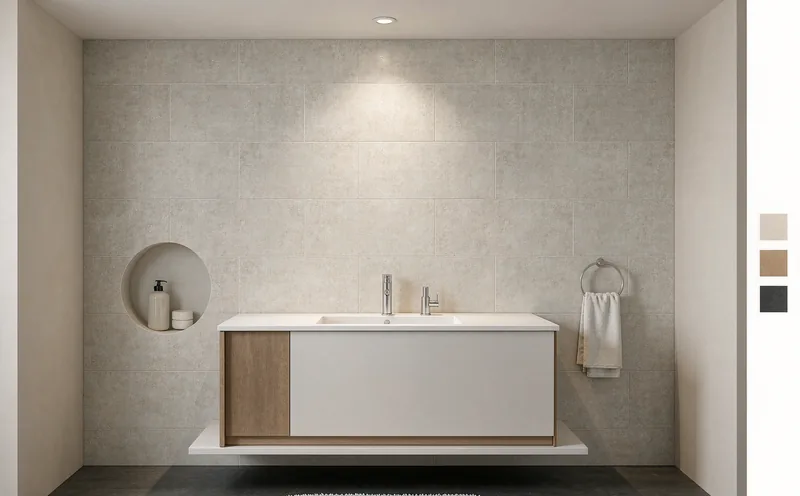
Scene-based selection removes the problem structurally. Carcass, wall tile, floor and lighting render in one real-time environment; recolor the cabinet and the reflections on the wall change, retile the wall and the cabinet gets re-judged instantly. PBR channels keep glaze and matte board on their own light paths, so the judgment happens under the same physics as the real thing.
Dimensions and Plumbing: The Costlier Trap
Wrong color is ugly; wrong size is rework. A vanity installs into a harder environment than a wardrobe — floor drain position, waste outlet height, pre-embedded piping, door frame width. One mismatch and the best-looking cabinet does not go in.
The mature approach writes those constraints into the system: enter the available wall width and oversized units disappear; pick a side-cabinet combination and the switch position gets flagged; declare a wall-drain or floor-drain layout and the compatible list filters itself. Everything a customer configures is installable by construction. The logic mirrors the wardrobe configurator, with harder constraints.
On the material side, four families render together — board, stone top, glazed tile, metal hardware — each on its own light path. Mixing them carelessly turns the scene muddy; per-part material management, as covered in our piece on showing different materials in Web3D, is baseline discipline here.
From Match to Order, One Step Away
Once the match is settled, the customer should walk away with a complete sheet: cabinet model, color code, countertop material, hardware list, dimensions, price. Walking into a showroom or sending an inquiry with that sheet leaves only delivery and installation to discuss — no more "so what does it actually look like" loops.
Brands gain a data asset too: which tile color families hold attention longest, which cabinet finishes get chosen — real preference data, cheaper and sharper than any survey. Across eight years and five hundred plus projects, Xuanji Animation has carried this method from wardrobes into bathroom furniture; the constraints grow, the approach does not. How configuration ties into pricing, with real before-and-after numbers, is in our analysis of return rates and order value.
To evaluate a bathroom line, the custom 3D configurator development page has the entry point.
Related Q&A
Does the whole bathroom need to be modeled?
No. The core scene is the cabinet plus two or three walls of tile around it. Buyers judge match and fit, not room tours — a small scene keeps models light, runs on phones, and costs less to build.
There are dozens of tile colors. Model them all?
Build the brand's hero colors and cover long-tail options with texture swaps. Tile is the cheapest material to vary by texture — one UV set, dozens of finishes, far below the cost of modeling each.
How does a store measurement connect back in?
The configurator accepts opening dimensions and filters accordingly, and the store uses the same constraint logic with measured data. Customers who configured at home and customers measured in store see one consistent proposal, not two versions of the truth.