
Modular sofas took off for a reason nobody advertises: delivery. An integrated three-seater that cannot turn the stairwell corner is a annual story, while modules carry in one by one and assemble in the living room. But handing the customer the freedom to combine also hands over the combinatorics — how many seats, which corner, fabric or leather, and whether any of it fits the room. A modular sofa 3D configurator closes that gap by letting buyers assemble the sofa inside their own living room before ordering.
The Freedom Is Also the Decision Burden
Once delivered, the questions change. Straight plus chaise, or corner plus armchair? Ninety centimeters of seat depth or a hundred? Does a high backrest block the window light?
Online, every option is an isolated photo. What the combination looks like assembled exists only in imagination, so the buyer asks support, support describes it in words, the buyer still cannot picture it — and that loop is where inquiry cycles stretch.
Assemble the Living Room in 3D
Scene-based selection starts from the buyer's room: enter the width and depth or pick a close floor plan, then drag modules into place. Corner left or right, chaise added or not — the layout shows whether walkways stay clear and how much floor remains.
Mass is the thing photos cannot carry. The same three-seater reads completely differently in a thirty-square-meter living room and a fifteen-square-meter one, and in 3D the answer appears the moment it is placed. Lighting simulates too: dark fabric sinks further in a dim room, light fabric lifts it, and one look in the scene beats ten articles of advice.
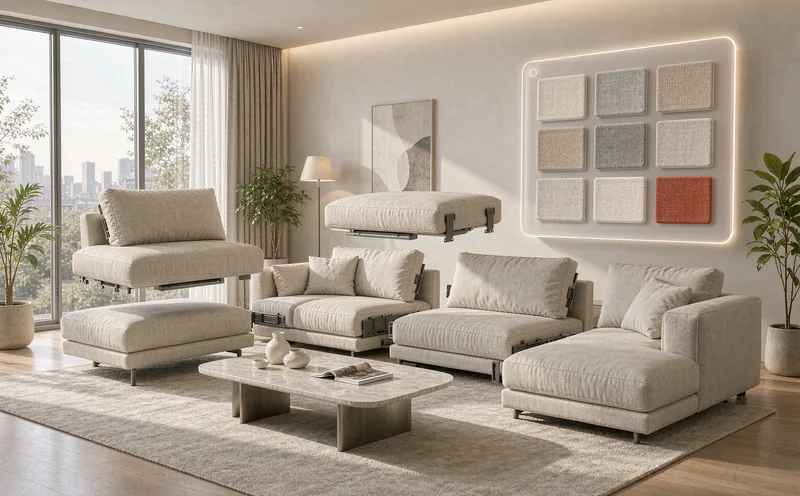
Fabric plays differently from cabinets. Weave, leather grain and the matte finish of tech fabric separate clearly in close-up PBR rendering, and swapping one module from tech cloth to linen restyles the whole room — which is also why furniture brands run selection across the whole space rather than per product. The curtain, the rug and the cabinet colors are already in the scene; recolor the sofa and everything re-judges at once.
Fabric and Feel: What 3D Gives, and What It Cannot
Honesty here builds the trust that sells. 3D carries the visual layer accurately — color, weave, sheen, the proportions of an assembled layout. It cannot carry the sit: foam firmness, backrest support, the difference between down and high-resilience foam. No screen replaces that.
So the mature flow does not pretend otherwise. 3D settles the visual decisions — which set, which color, how it sits in the room — and the store visit becomes a targeted confirmation instead of a search from zero. For brands, showroom walk-ins arrive qualified; for export and out-of-town buyers, opening the configuration link on a video call and walking through the buyer's own arrangement cuts communication cost by an order of magnitude.
Returns tell the same story: most sofa returns trace back to "not what I expected" — darker than the photo, bigger than imagined, off-style with the room. Buyers who assembled, recolored and compared in 3D carry a much tighter expectation gap; the numbers are in our analysis of return rates and order value. How fabric realism gets built for the web is covered in showing different materials in Web3D.
Xuanji Animation has delivered five hundred plus projects over more than eight years, carrying selection systems from cabinets into soft furniture, and the rule holds across both: the freer the combinations, the more buyers need a place to rehearse. Starting one from zero is documented stage by stage in our furniture 3D configurator guide. To evaluate a sofa line, the custom 3D configurator development page has the entry point.
Related Q&A
How many models does a modular sofa configurator need?
Model by module, not by finished product. One base model each for armless, corner, chaise and ottoman, with fabrics and colors layered as parameters — dozens of finished combinations from five or six base models. The real effort sits in fabric fidelity and assembling the combination rules.
Do buyers need to upload photos of their room?
Two modes work. A template room close to their floor plan gives instant preview; photo upload with real-scene blending is more persuasive but costs more. The common path is launching templates first, adding real-scene capability once the flow proves itself.
Will buyers regret the feel after ordering?
Only if the site pretends 3D can do what it cannot. Say plainly that sit and touch need a store visit or a fabric sample, and let 3D own what it owns — color, combination, placement. The in-store sit then confirms a decision instead of discovering a mistake, and the gap stays small.