
Whether Shopify 3D configuration is the right home for your product, and on which platform it should sit, stalls a lot of exporters before work even starts. If customers pay on the spot, Shopify is plainly less work. The moment the sale becomes a quote, a sample and negotiated terms, Shopify's structure starts to feel wrong. The deciding factor is not which platform is stronger — it is how you sell.
One clarification up front: both platforms can host 3D configuration. Neither is incapable. What differs is the cost of wiring it in, how hard it is to maintain, and where the order finally lands.
Three questions that settle it
Does the customer pay after looking, or ask for a quote first? This one carries the most weight. Paying on the spot implies public prices, stock on hand and standard shipping — exactly what Shopify's checkout was built for. Asking for a quote implies the same product priced differently per customer, and a public price system cannot express that without bending variants and discounts until maintenance becomes the job.
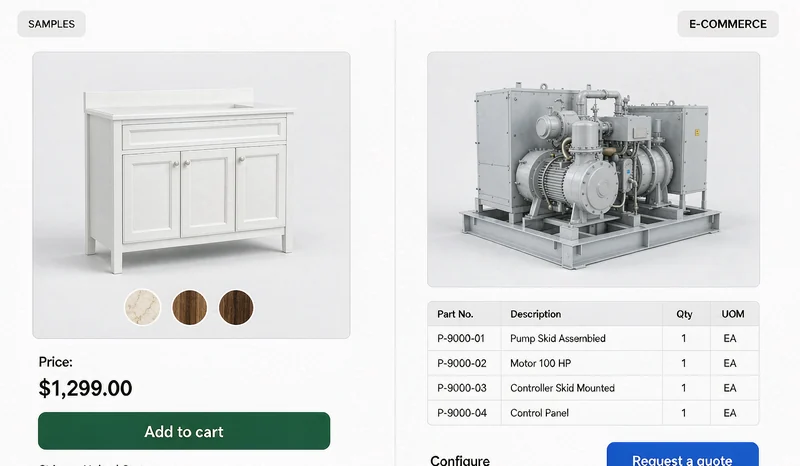
How many specifications does a product page carry? Consumer products usually run to a dozen. Industrial and custom equipment often run to dozens, split by model and variant, with drawings attached. Shopify handles the description text; structured spec tables, cross-model comparison and technical downloads need plugins or custom work, and the platform's structure limits how far that goes.
Is there a market that needs a native speaker to rewrite the copy? With an English-only site, Shopify is enough. With Spanish, Arabic or Russian sub-sites, each with its own page structure and keyword set, self-hosted gives more room. The same point appears in moving from static galleries to interactive Web3D — multilingual coverage and SEO control are where self-hosting wins.
On Shopify, configuration travels as order properties
Once Shopify is chosen, the technical question is how a configuration reaches the order. Simple colour and material swaps are fine with an App Store plugin. As soon as there are exclusions between options, pricing by dimension, or component quantities, the plugin template hits its ceiling and a custom app becomes necessary.
The practical route is to pass the selection as line item properties rather than pre-building a variant per combination — a variant list cannot carry the permutations of dozens of options and will eventually be maintained wrong. That route is detailed in Shopify 3D configuration when variants run out, from variant logic through order fields.
Shopify's advantage is that it takes work off your plate: checkout, payment, tax and shipping are handled, and 3D only has to cover the product page. The cost is that deep customisation runs into platform rules — checkout pages and URL structure are largely fixed.
On a self-hosted site, the endpoint is an inquiry, not a checkout
Self-hosted 3D configuration usually delivers not an order but an inquiry carrying the full configuration. The buyer selects model and options, enters company, quantity and lead time, and submits. Sales receives something they can quote from without another email round.
The freedom is greater. Page structure, URLs, specification tables, languages and structured data can all be arranged for search, the 3D module can sit wherever it belongs, and loading strategy is yours to control. The cost is that everything extra is yours to maintain — server, backups, security updates, plus form handling and archiving.
For custom products the inquiry often continues into a BOM and a quotation. Where that line sits — what can be calculated automatically and what needs a person — is discussed in 3D configurator for B2B: quote or cart, and worth settling before build.
Can the 3D assets leave with you
This is the least-asked question at selection and the most painful later. Models, textures, rule tables and price lists are theoretically your assets, but whether they can travel depends on how they were delivered.
Shopify data exports; themes, plugin configuration and custom fields do not. Moving platform effectively means rebuilding the front end. Self-hosted, if code and data sit in your name, migration is more open. Whichever you pick, the contract should state ownership and export format for model source files, rule tables and price libraries. That clause matters more than a few thousand saved on the build.
There is a further layer: the configurator engine itself. Some SaaS arrangements grant usage rights only — the engine is not transferable and cannot be self-hosted, so content can be updated but the system cannot leave. Those options start fast and cheap, and the lock-in risk is yours to weigh.
Running both paths is a legitimate option
A common sequence is to validate a category on Shopify first, then build a self-hosted site for brand and long-tail search. The appeal is not committing build budget before the product proves itself.
The downside is split customer data and split content assets: the same 3D model gets wired twice, and every change happens in two places. If you take this route, build the 3D assets as portable components from day one — one lightweight model set, one rule table, both platforms reading from the same source. The second launch then costs very little.
Across eight-plus years and more than 500 projects at XuanJi Animation, platform regret tends to follow one pattern: build the easiest thing first, then discover the structure cannot hold a wider range or a second market, and start over. Scope is described on the Web3D website development page. We build both Shopify and self-hosted — the choice follows how your customers buy, not which platform is trending.
Related questions
Can customers pay directly on a Shopify 3D configurator?
Yes. The configuration enters the cart as order properties and runs through Shopify's native checkout, with payment, tax and shipping handled. The precondition is clear pricing rules that do not need human review.
Can a self-hosted 3D configurator also use add-to-cart?
Technically yes, though most self-hosted sites use inquiry. Where there are standard products to sell online, design the two paths separately — standard to cart, custom to quote — rather than merging them into one button.
If we move from Shopify to self-hosted later, is the 3D work redone?
Models and rule tables carry over; front-end integration and pages are rebuilt. That is why models should be treated as platform-independent assets from the start, not tied to a theme or a plugin.