
Many companies pick the wrong conversion path for a cross-border 3D configurator before the project even starts. They see 3D configuration working on Shopify, imitate the add-to-cart flow, and then discover that their buyers are expected to pay online — while the real transaction is a quote, a sample and a contract. The cart is not an accelerator here. It is an unnecessary wall.
Add-to-cart and inquiry are two different systems underneath. Pick the wrong one and the form, the fields, the back end and the sales process all need rebuilding.
Who is actually buying
B2C decisions are short: someone sees a product, likes it, orders, pays. Prices are public, stock is on hand, shipping is standard. Add-to-cart is the shortest path, and the configurator's job is to reduce returns by letting buyers see what they are getting.
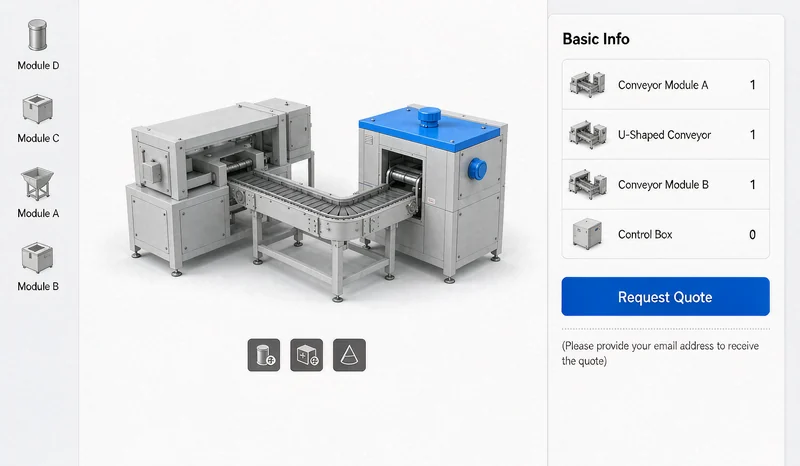
B2B foreign trade runs on a different chain. The buyer may be procurement, engineering or a distributor; price is negotiated, terms are negotiated, certification is confirmed, samples are made. Nowhere in that chain does "pay now" appear. The inquiry is the starting point. Forcing a cart onto it means the buyer walks halfway down a path and finds it blocked.
The test is simple. Ask whether the same product is quoted at different prices to different customers. If yes, it is B2B — skip the cart.
What an inquiry must carry to be worth building
The value of a configurator-generated inquiry lies entirely in sales knowing how to quote. If what arrives is "a customer is interested in product X", it is no better than a generic contact form and the 3D work was wasted.
A usable inquiry answers three questions: which base model, which options, and which material or process codes those options map to. The first two are for the buyer; the third is for the factory. That mapping has to be agreed with production at project kickoff — otherwise the fields look neat and sales is still on the phone.
One detail matters more than it seems: with multi-option products, buyers often submit halfway through. The form should accept a partial configuration plus a note, not demand completion. Forcing every field drives away the undecided. The form design guidance in the configurator build process says the same thing.
How far BOM and quoting should go
Many proposals advertise automatic BOM generation and PDF export as the headline. The capability is real, but two cases need separating.
Where options map to standard parts and pricing rules are explicit, calculated prices and generated quotes are workable — the number the system produces is the number you can send. Where customisation is heavy and engineering judgment is involved, the system produces a reference price and a person still sets the final figure. Automating that stage creates a problem rather than solving one, because buyers will use the system price as leverage.
A more reliable design layers it: the configuration becomes a structured list automatically — model, components, quantities, notes — while the price column is filled by a person or routed for approval. ERP integration follows the same order: get the data right first, automate order creation later. Reversed, it causes real damage. The boundary is discussed in the piece on industrial digital catalogs — how far a tool should go depends on how mature your business rules are.
What 3D actually contributes on this path
Adding a configurator does not reliably increase inquiry volume. What it changes is inquiry quality and the number of rounds.
After a buyer has rotated the product, opened it up and switched finishes, the questions get specific: this component's material, whether a particular installation works, lead time on an option. Those inquiries may not be more numerous, but they cost far less to follow up, because nobody has to start from "here is what our company does".
In the other direction, a product with no configuration dimensions and buyers who do not care about structure sees little return. There, better photography and a clear specification table win. The reasoning matches interactive versus static product pages — the tool has to match the decision.
Foreign-trade sites add one more consideration: buyers sit in multiple time zones and nobody is on duty when they browse. A configurator plus inquiry form lets the page complete a full requirements capture at three in the morning, so sales starts the day with a lead that already carries a configuration.
After launch, do not watch inquiry count alone
Total inquiries mislead. More useful: the share of inquiries that carry a configuration, how complete those configurations are, and how long sales takes to quote. Those three reflect whether the system is working.
A low share with configuration usually means the entry point is wrong — buyers never found the configurator, or abandoned halfway. Low completion suggests too many options or too long a path. No improvement in quoting time means the data arriving is unusable and the fields need redesigning.
Across eight-plus years and more than 500 projects at XuanJi Animation, B2B outcomes are usually decided before development starts: option rules, pricing logic and the fields production needs. Settle those and development is execution; leave them vague and the result looks impressive and goes unused. Scope is on the custom 3D configurator page — if your product has configuration dimensions, list those three things before discussing a proposal.
Related questions
Can a B2B site support both inquiry and add-to-cart?
Yes, if they are designed separately. The common pattern sends standard products to the cart and custom builds to an inquiry, each path complete on its own. Merging them into one button leaves the buyer unsure which to press.
Without online payment, is a configurator still worth it?
Yes, and its value concentrates pre-sale. It lets buyers understand the product themselves and frees sales from repeating the same explanation. The return shows up in communication efficiency, not at checkout.
How detailed should the inquiry form be?
Detailed enough for sales to quote directly, no more. Cramming in dozens of fields means nobody fills it. Model, options, quantity, lead time and a free-text note cover most cases.