
An energy storage container in 3D solves a specific problem. From outside, a containerised battery system is a tidy steel box; the value sits inside it — cell racks, liquid-cooling loops, fire detection, busbar layout. Overseas buyers cannot see a unit, so they judge from two cutaway drawings and a parameter table, and that judgment goes wrong easily. The dimensions fit, but the maintenance aisle may not. The capacity fits, but the thermal strategy may not suit the local climate.
New-energy equipment carries long purchase chains, high unit values and multiple decision makers. If the 3D view only spins the enclosure, it contributes almost nothing. What helps is showing what is inside and how configurations differ.
Anyone can spin the housing; buyers need the interior
An enclosure-only model adds close to zero information, because the outside is genuinely simple. What buyers care about is inside the box: how racks are arranged, how modules are withdrawn, where the cooling loop runs, where fire detection sits, how wide the service aisle is.
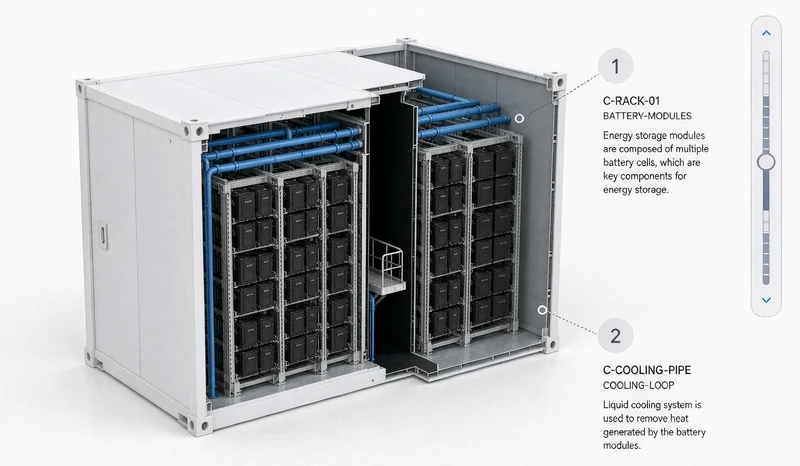
Cutaways are the main instrument. Drag a slider, one side of the housing disappears and internal structure is revealed continuously, at the buyer's own pace — rack count, spacing, orientation. That continuous transition beats a static section drawing because it builds spatial understanding instead of asking someone to infer three dimensions from one image.
Layered views handle a different question: assembly and service logic. Components separate along the installation axis, so a buyer can see whether modules are front-serviceable, how much room a swap needs, how piping and harnesses route around each other. For EPC contractors and O&M teams this is a hard requirement; for the person signing, it is where confidence comes from.
Explaining variants without a row of separate models
Storage variants rarely differ on the outside; they differ in capacity, cooling method and grid-connection scheme. The buyer's question is which configuration suits their project, not how many models a supplier lists.
The workable approach is one base model carrying variable parameters: capacity expressed by adding or removing racks, cooling shown by switching air-cooled and liquid-cooled piping, grid connection mapped to different distribution modules. Switching inside one interface makes differences visible; bouncing between five separate models makes buyers rely on memory.
This parameter-driven approach resembles custom furniture configuration, except that storage options are tightly constrained by engineering — many combinations are physically invalid. Those exclusion rules have to be encoded, so a wrong combination is refused on the spot rather than discovered at quotation. The rule-mapping part of the configurator build process covers how to do that.
Building trust without a physical unit
Storage inquiries from overseas come mostly from contractors, EPC firms and distributors. They cannot fly in to see a unit, and shipping samples is expensive, so they judge on three things: whether the structure is sound, whether certifications are complete, whether delivery is documented.
3D covers the first. The other two need annotation. Attaching certification, ingress protection and operating temperature range to the relevant components means a buyer exploring structure also sees the boundary conditions without switching documents. It looks minor and removes a large volume of repetitive email.
Language is the other practical issue. Storage has a dense technical vocabulary, and English copy needs review by someone who knows the product. Machine translation that mixes "battery cluster" with "battery rack" tells a specialist immediately that the supplier is not serious, and trust drops on the spot.
Redaction is the third layer. Some structures are patented or process-sensitive, and showing everything publishes the drawings. Standard practice is limiting the cutaway range, using simplified schematics and blurring critical dimensions. Settle this at kickoff; changing it halfway means rebuilding.
Much of this carries over from equipment 3D interaction, with storage adding extra sensitivity around safety-related structures.
Load and device targets, decided early
Storage containers are naturally heavy models: frame, modules, pipe elbows, harnesses — detailed and repetitive. Built literally, a full unit runs to tens of megabytes and will not open on a phone. A meaningful share of overseas buyers check links on mobile data, at a show or on site.
The fix is setting the budget at the start. Exterior parts keep silhouette, internal parts are tiered by display need, repeated modules are instanced rather than modelled individually, and textures carry detail. Keep total weight in a sane range, and split into "overview" and "interior" loading tiers where necessary — whole unit first, depth on demand.
Devices should be planned separately. The web build prioritises load time and touch; a booth build can carry higher render quality and auto-play pacing, sharing one source model so the two do not drift. The cost logic is the same arithmetic used for showroom investment — reuse rate decides value.
Across eight-plus years and more than 500 projects at XuanJi Animation, the most common rework on equipment work is discovering after modelling that mobile performance fails and lightweighting has to be redone. That cost is avoidable. Scope is on the Web3D project development page; for multi-configuration products like storage, settle the configuration rules and the load budget in the requirements phase.
Related questions
Our internal structure is confidential — can we still show it in 3D?
Yes. Limiting the cutaway range, substituting schematic structure for the real layout and blurring critical dimensions are all standard. Decide first what the buyer needs to judge, then show only that.
Can this be done without CAD data?
It can, at lower fidelity. Storage internals are complex, so without CAD the work depends on physical measurement and both cost and schedule rise. With 3D data, modelling time drops substantially.
Will switching configurations make the model very heavy?
Not if controlled. One base model driven by parameters is far lighter than a separate model per configuration — provided the rules are mapped before development rather than added as you go.