
Whether a 3D virtual showroom is worth building has little to do with the technology and everything to do with how you use it. The same build can become the place where trade-show leads get followed up, or a digital specimen nobody maintains. The difference is rarely budget — it is whether anyone decided, before work started, who walks in and what they are there to do.
One misunderstanding is worth clearing first. A virtual showroom is not an upgraded website, and it does not replace a booth. It exists for three situations: the buyer who cannot travel, the product that cannot be shipped, and the salesperson who cannot explain everything in one call. It works alongside product pages and catalogs rather than instead of them.
A showroom and a product page do different jobs
A product page has one purpose: let someone who searched a specific model confirm it fits, quickly. It should be narrow, deep and complete on specifications. A buyer arriving from search needs certainty within thirty seconds, then either a download or an inquiry form.
A showroom serves people who have not shortlisted yet. Distributors want to see how the whole range is organised; engineering buyers want to gauge how deep your experience runs in their sector; new prospects want a fast read on scale. None of that fits a product page, which is fragmented by design.
Running both is the sensible structure, which is why a Web3D site is designed differently from a standard website. The showroom builds an overall impression and routes visitors; product pages carry the depth. Cramming every model into the showroom usually produces a visitor who wanders between rooms and absorbs nothing.
One model set, three contexts
The economics come from reuse. The same assets can serve the showroom on your site, a booth screen at a trade fair, and an offline package on a sales tablet. The interaction priorities differ, but the underlying data is one set — change it once and all three follow.
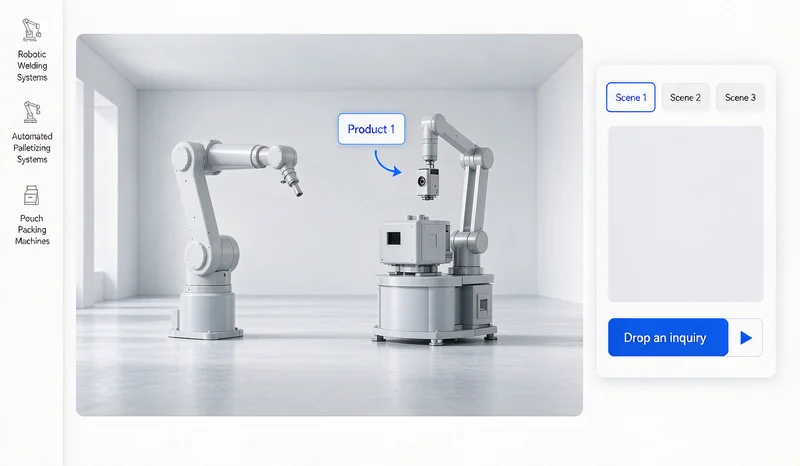
Trade shows make this obvious. Equipment that cannot be shipped, floor space that cannot hold it, staff who cannot cover every visitor — that is the normal state of a booth. A showroom running on a touchscreen lets visitors explore while they wait, so the conversation starts further along. Abroad this has settled into a recognised format under the name virtual industrial showroom, positioned explicitly as one link replacing brochure plus booth.
One detail is easy to miss: sales staff must be able to edit it. If a product line changes or a flagship model is replaced and every edit needs a developer, the tool quietly stops being used. Whether the back end allows swapping models and rewriting talking points decides if the project is alive in three months.
Where the money goes, and where it overruns
The cost structure differs from a single product page. A product page concentrates spend on model fidelity and interaction depth. A showroom adds a layer for space and navigation — scene building, route design, camera transitions, loading strategy — and that layer is the easiest to underestimate because it has no obvious unit price.
Overruns come from two directions. Loading the entire range at once, so model count and scene complexity explode together. Or chasing cinematic quality, applying trailer-grade lighting, materials and post-production until a single scene weighs tens of megabytes and mobile visitors give up.
The control is plain. Put only the flagship lines in version one, with three to five stops, and expand after real visitors prove they use it. Set the visual bar at "structure is legible", not "looks like a commercial". Industry practice keeps a single scene within a few megabytes to the low teens; beyond that, mobile experience degrades noticeably.
Signals that it is worth doing
When buyers are spread across many countries and site visits are expensive, a showroom pays back quickly. When the product is bulky, cannot travel, and every demonstration takes a crew, it is close to essential. When a large distributor network needs consistent messaging and a single presentation standard, it removes a lot of training cost.
In the other direction, a single-product company with local customers who decide face to face has little urgency; money is better spent on product pages and a solid catalog. One more caution: if nobody internally can maintain the content, the asset starts depreciating the day it launches.
Do not decide on the grounds that competitors have one. Their customer mix may not resemble yours. The logic matches choosing a 3D configurator partner — start from your own situation, then look at the proposal.
The real waste is the abandoned build
These projects fail in a predictable way. A loud launch, then six months later the models are stale, the talking points reference the previous product release, and sales has stopped mentioning it. The cause is almost never obsolete technology; it is the absence of an owner.
So settle three things during planning: who updates the content, how often, and how long an update takes. If the answer is "next time we redesign the site", the showroom will not survive. A workable arrangement ties updates to the product release cadence, so a new launch swaps the featured slot at the same time.
Do not skip measurement either. Which products get opened, where visitors drop off — that data shapes version two. A showroom without tracking is optimisation done blind.
Across eight-plus years and more than 500 projects at XuanJi Animation, the showroom builds that lasted all had a named internal owner. Scope and deliverables are set out on the Web3D project development page; how to phase the range, and what to build first, follows directly from your flagship models.
Related questions
How is a 3D showroom different from a normal website?
A website centres on information and conversion, with flat pages. A showroom centres on space and exploration, with a visitor moving through it. They coexist — the showroom is usually an entry point from the site, not a replacement for the homepage.
With a limited budget, build the showroom or the product pages first?
Product pages. They capture search traffic directly, show results sooner, and generate the model assets a showroom later needs. Once the flagship models exist, organise them into a showroom.
Can a showroom generate inquiries directly?
Yes, if the route is designed for it. Whenever a visitor reaches equipment of interest, a request-for-documentation or book-a-demo entry should sit beside it — not back on the homepage after the tour ends.