
Appliance brands have moved 3D product display from novelty to baseline. Most of what gets built, though, still stops at "spin it around and look at the front". LG is the useful case because it went further: RetailVerse launched on LG.com with forty best-selling appliances as interactive 3D models — doors open, washer drawers pull out, AR confirms whether the unit fits your cabinet. What is worth studying is not that they used 3D. It is how they made 3D a reusable asset.
For appliance, kitchen and small-appliance brands in China, that distinction matters. Long ranges, many variants and fast refreshes are the shared condition, and 3D content fails exactly where those conditions bite: build a batch, leave it for two years, discover all of it is out of date.
What LG actually assembled
Four layers, and the thing does not run without any of them. Models are generated from original manufacturing CAD, so hinges, shelves and internal dividers match the physical unit — when a door opens, the buyer sees the real structure rather than an artist's impression. Interaction adds hotspots and motion: click a point for a feature explanation, open doors and pull drawers as they actually move. Space adds AR and dimension visualisation, placing the appliance at true scale in the buyer's kitchen to check whether it blocks the walkway. Management is RetailVerse Configurator, a content platform that lets marketing update models and copy and push them to LG.com and retail partner sites.
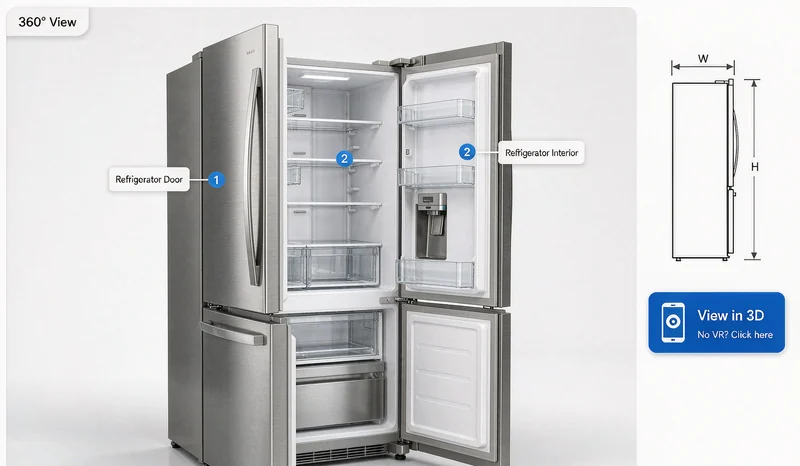
The detail worth pausing on is production time: LG reports AI-driven automation cutting a single model from weeks to under a day. For a multi-SKU brand that number is the whole ballgame. The more variants a range has, the worse manual modelling economics get, and the outcome is predictable — flagship models ship, the long tail never does.
Which layer to copy, which to skip
The automation and management layers are not a short-term copy. They need clean CAD data, internal process change and sustained investment. Attempting them without that foundation usually ends with a licensed platform and nobody filling it.
What is copyable is the interaction discipline and the long-tail strategy. Appliance decisions concentrate on a few concrete questions: is this capacity enough for my household, will this width fit through my door, how is the interior organised, how hard is it to clean. Answering those four in 3D beats twenty decorative hotspots. Exterior finish, meanwhile, is largely covered by good photography and a short spin video.
Long-tail handling is where the money sits. Build one template per category, let variants share materials and interaction logic, and swap only dimensions and structural differences. That cost structure looks nothing like building each model from scratch. The same logic runs through build versus plugin versus SaaS — the goal is turning a one-off spend into a reusable asset.
For multi-SKU brands the hard part is operations
With a broad range, the question is no longer whether one impressive page can be built, but how fast the whole set follows a new launch. Appliances refresh quarterly: new models in, old models out, specifications adjusted. If every change needs a developer, the 3D content falls behind the catalogue and becomes an archaeological layer on the site.
That is why back-end capability deserves more scrutiny than front-end polish before signing. Can the team swap a model, edit specifications, rewrite hotspot copy without help? How long does one change take? Is there version control? The answers decide whether the investment is still alive in three years — the same lesson that shows up in 3D virtual showroom projects, where unmaintained assets depreciate faster than anyone expects.
One more step is easy to skip: the handoff between photography and 3D. Appliance buyers build trust from real photos first, then want structural depth. Show a static image with key dimensions on the first screen, put a "view in 3D" entry beside it, load the model only on interaction. Reversed, the page goes blank while the model downloads and the buyer leaves.
Budgeting without a per-model price
Estimating by model count always overshoots. Appliance 3D costs come from four places: number of models, interaction depth, device coverage and ongoing maintenance. Model count is arithmetic. Interaction depth is where estimates break — doors that open, shelves that come out, finishes that switch; each layer is a step change in work, not a percentage.
Device coverage needs its own line. Mobile is an order of magnitude below desktop, so the same model may need reduced geometry and no real-time shadows on phones — effectively two versions. Skip this and the mobile experience collapses, which matters because appliance research skews heavily mobile.
Maintenance belongs in the first contract. Industry practice is a first year included, then an annual renewal scaled to update frequency. A supplier who quotes only development cost and dodges maintenance will be harder to deal with later.
Across eight-plus years and more than 500 projects at XuanJi Animation, appliance and consumer-electronics briefs share a pattern: long ranges, many samples, expensive in-store display. The return tends to appear in fewer physical demo units and shorter sales-floor explanations, not just a better-looking site. Scope is on the Web3D project development page; broad ranges are best phased by category.
Related questions
Which appliance models should be built first?
The best sellers, the ones that generate the most questions, and the ones with the highest return rate. Those usually overlap heavily, and they produce feedback fastest. Fill the long tail once the template is proven.
Do we need to supply CAD files?
CAD is better — structure and dimensions come out accurate. Without it, physical measurement works, but internal structure fidelity drops. For appliances whose selling points live in internal layout, that trade-off deserves a decision up front.
Will it lag on phones?
It depends on the model budget. Keep a single model within two to three megabytes and show a static image first, and it will not. The compression approach is covered in keeping models under 2MB.