
Home Appliance 3D Interactive Display Development
Home appliance 3D interactive display turns colors, material detail, door opening and function hotspots into an online demo customers can operate, instead of relying on a few fixed product photos.
Custom-built for appliance brands and ecommerce teams, serving websites and product pages. It focuses on visualizing appearance, structure and functions; embedding in product pages and purchase flows is assessed per project.
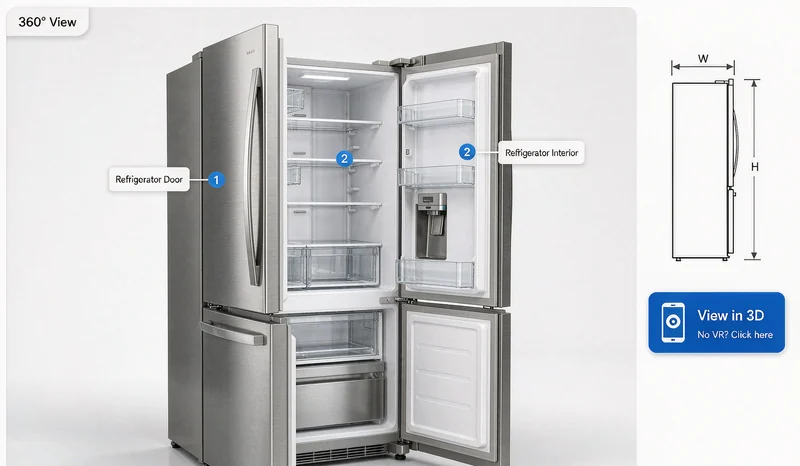
Appliance 3D preview: opening, structure and function hotspots.
Common Needs in Online Appliance Display
For refrigerators, washing machines and air conditioners, differences in color, panel material and internal structure are hard to convey in a few photos. Buyers want to see inside the door or where a function sits and often find no intuitive answer.
3D display brings these needs into one operable interface: rotate to see the exterior, open to see the structure, click hotspots for functions. Customers get more complete information and spend longer on the page.
Details Hidden
View colors and material details up close.
Internal Structure
Demonstrate interiors with door opening and exploding.
Function Location
Hotspots mark parts and operating positions.
Colors, Materials and Product Details
Switch panel colors and materials on one product and compare brushed metal, glass or matte finishes; zoom into corners, handles and displays. What can be switched depends on assets and finishes.
Color appearance varies across screens and lighting, so online views compare directions and final colors are best confirmed physically. Implementation is covered in our interactive 3D product display service.
Before development, we confirm which models and details matter most, then decide whether to use switching, zoom or hotspots to avoid an overloaded page.
Colors & Models
Compare panel colors and materials.
Surface Finishes
Show brushed, glass and matte textures.
Detail Zoom
Close-ups of handles and displays.
Opening, Exploding and Function Interaction
Actions like opening a refrigerator door, a washer hatch or an air-conditioner panel can be animated to show internal structure and use. Function hotspots sit on a part and reveal a description on click.
Interactions are designed around the real product and user questions, without gratuitous motion; parameter descriptions follow customer materials.
Demo actions and hotspots address real usage questions, with parameters following customer-reviewed materials.
Brand Websites and Ecommerce Product Pages
Brand websites use display pages to explain product ranges and functions, while ecommerce product pages focus on selection and checkout. Embedding 3D in product pages and linking color options depend on platform interfaces and product data.
Configuration selection and purchase flow are extension scope discussed per project. Related services are covered in our 3D configurator development service.
Placing display where customers decide usually works better than a separate display site.
Brand Websites
Show ranges, appearance and functions.
Ecommerce Product Pages
Design display and selection around the catalog.
In-Store Screens
Demonstrate more models with limited display space.
How Appliance 3D Interactive Projects Are Delivered
Start with one key product, get the display flow working, then expand to the range. Scope, schedule and cost are subject to assessment and the project contract.
Define the Product
Confirm models, structure, function points and focus.
Create Models
Build and optimize web-ready 3D assets from materials.
Develop Interactions
Implement switching, opening, exploding and hotspots.
Test and Deliver
Check display across devices and the core flow.
Related Questions and Answers
Can it embed in ecommerce product pages?
Integration is assessed against platform architecture, product data and interfaces; syncing models or cart data is defined during requirements gathering.
Can the page show real specifications?
Specifications follow customer-reviewed materials; the page visualizes and does not infer specifications.
Can it be made without 3D models?
Provide product images, dimensions and materials so we can assess modeling scope and propose a workable approach.
Ready to Start? Get Your Tailored Plan
Submit your requirements to receive a technical plan, timeline and budget within 24 hours.